Hey Gang,
Welcome to Think Spot. Welcome back for some of you. Please click on the link below and register. I'll try to guide you through the rest.
TEDEd Lesson & Discussion
From the cluttered mind of C, Teacher
School District of Waukesha
Waukesha STEM Academy
Thursday, October 17, 2013

Thursday, August 15, 2013
Day 4 of Design Team Boot Camp: Themes and Observations...
 |
| Conflict: Blame others, point fingers, and pass judgement. |
So far, we have covered 3 of the 5 themes of the week. Those 3 themes are:
Day 1- Ideation
Day 2- Revisit & Review Ideas
Day 3- Selection
Yesterday's theme was Selection. What Mr. H and I observed was a little conflict and disagreement as decisions were being made to bring ideas forward. We also noticed that constraints are becoming apparent when we think about designing a solution to the earthquake/building problem. As a learning community, we are all engaging and participating. Engagement and participation are two things that make Design Teams function at high levels.
 |
| I-Messages: Describe a behavior or situation; not a personal judgement. |
The activities that Mr. H and I have designed will push you and your Design Teams to the next level. Differences of opinion, conflicting ideas, disagreements, and frustration are all natural challenges that even the best Design Teams face in the real world. Adults face these challenges all the time. Today, lets make listening our driving intention so that tomorrow's final designs demonstrate the best our Design Teams have to offer.
As we head into today, remember to listen to our Design Teams. Let's have fun and enjoy our Professional Play.
Sincerely,
C & H
P.S.
 |
| I-Messages: State and own feelings |
From the cluttered mind of C, Teacher
School District of Waukesha
Waukesha STEM Academy
Monday, August 12, 2013
Day 1 of Design Team Boot Camp...
Good Day Design Team,
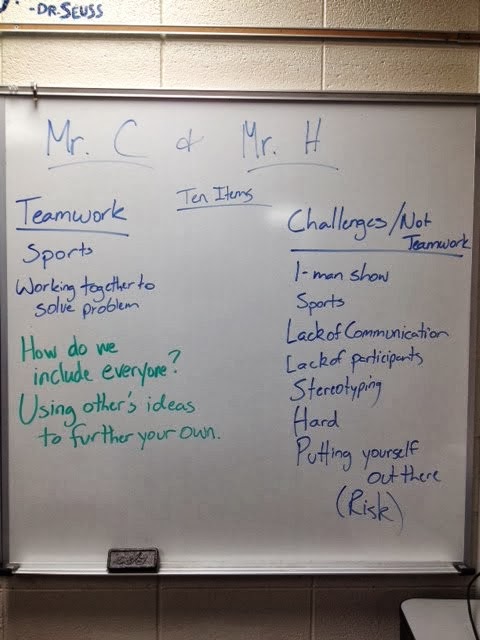 Mr. H and myself are extremely happy and proud of the way our first day went. You are all amazing thinkers with tons of potential. This boot camp is designed to develop your ability to generate many variations of your ideas as well as combine them with the ideas of others to innovate and create. In order to do this as a Design Team we have to learn certain habits of mind so that we can practice them with others.
  So far, we have spent time defining teamwork as a group, we have identified challenges that sometimes get in the way of teamwork, and stumbled upon some really great questions that will deepen our understanding as we grow as a Design Team.
 |
| How are mistakes and/or failures good things? |
All throughout this blog post you will find pictures that log our work, our discussions, our questions, and habits of mind. Click on some of the questions to see if you can think of any answers we have discovered. Remember, we have learned:
1. Think alouds
2. Read alouds
 |
| How do we share "AIR TIME"? |
4. Reading a Visual Image
5. Turn & Talk (Think-Pair-Share)
 |
| How do we make sure everyone is included? |
 |
| Reading a Visual Image |
We are looking forward to the rest of the week. Enjoy yourselves and be sure to engage. We love hearing your voices, your ideas, and your enthusiasm. Our Design Team will only get better because of our work together.
 |
| Why is listening sometimes harder than speaking your thoughts? |
Sincerely,
Mr. C & Mr. H
 |
| What do you do after you realize a mistake and you have put a bunch of time in to your work? |
Friday, May 10, 2013
Reframing Misconceptions: Historic Dates...
Dates are not facts to be remembered.
Dates are tools to help us frame a perspective and measure our understanding within the chronology of time!!
Sent from my iPhone
Dates are tools to help us frame a perspective and measure our understanding within the chronology of time!!
Sent from my iPhone
Thursday, May 9, 2013
Aftershock: Beyond the Civil War, CC/CH, & UP...
Hey Nearly High Schoolers,
 Happy Thursday to you all and I wish you the best of luck on your MAP testing both today as well as next Tuesday. Today, in continuation to the direction we are heading, we will be attacking a piece of text with a question in mind and viewing a documentary. The question we are using to attack text is this: How does "inequality" affect the American Dream? If this question does not suit you, if you would prefer to read with a question that you have generated yourself, then rock out with your bad self! You are all asking some phenomenal questions. Remember that when we attack text by using a question we are trying to construct meaning, make connections, and find RELEVANT INFORMATION.
Below is a short synopsis of what the documentary is about. It is the hope of this teacher that the events, people, and themes we find in this documentary in addition to the relevant information we read in our texts will help us as we try to THINK LIKE HISTORIANS.
 Aftershock: Beyond the Civil War is a series of videos that examines and documents life after the Civil War. The series portrays a violent aftermath of greed, violence, anger, intimidation and fear that occurred during the Reconstruction Era. Many history books fail to portray this period of American history as vividly or in such detail as shown in this series. Many post Civil War stories for people and groups like ex-Confederate soldiers, Southern civilians, Afro-American and Native American troops are highlighted. The series includes many images of a time after the Civil War that includes the bloody surrender at Appomattox to the rise and decline of the Ku Klux Klan. The series depicts the plight of various segments of the Southern society; poor whites, newly freed slaves, returning soldiers and Southern white landowners. To see a picture of what happened to people who fought against each other and interacted during the period of rebuilding their country and lives
One final thought...
These are the learning targets we will be reflecting on after this week's work. Just something else to chew on.
Media in Social Studies: I can identify main ideas, analyze supporting details, and evaluate inferences within discipline specific readings
Content in Social Studies: I can apply content in order to evaluate relationships of people and ideas and draw conclusion
Yours Truly,
C
From the cluttered mind of C, Teacher
School District of Waukesha
Waukesha STEM Academy
Below is a short synopsis of what the documentary is about. It is the hope of this teacher that the events, people, and themes we find in this documentary in addition to the relevant information we read in our texts will help us as we try to THINK LIKE HISTORIANS.
One final thought...
These are the learning targets we will be reflecting on after this week's work. Just something else to chew on.
Media in Social Studies: I can identify main ideas, analyze supporting details, and evaluate inferences within discipline specific readings
Content in Social Studies: I can apply content in order to evaluate relationships of people and ideas and draw conclusion
Yours Truly,
C
From the cluttered mind of C, Teacher
School District of Waukesha
Waukesha STEM Academy
Tuesday, May 7, 2013
Welcome to WEST!!
Greetings Wolverines and STEMers,
 Here we are again guys and gals! Your time here in Jonas's class will flow in 3 phases. The phases are below and we will be referring back to this blog post frequently throughout the class.

"Control in modern times requires more than force, more than law. It requires that a population dangerously concentrated in cities and factories, whose lives are filled with cause for rebellion, be taught that all is right as it is. And so, the schools, the churches, the popular literature taught that to be rich was a sign of superiority, to be poor a sign of personal failure, and that the only way upward for a poor person was to climb into the ranks of the rich by extraordinary effort and extraordinary luck."
Over the past few weeks as I sat down to think about The American Dream and what it has looked like for Americans over the course of history, I have asked some of these questions. Perhaps while you engage your partner in thinking and academic conversations these questions may help you generate some questions of your own.
1.Which aspects of the human experience were constant from 1801-1930?
Follow-up: Which of those aspects can we still see today in the 21st century?
2. Based on what we are reading, watching, and interacting with which parts of the past are comparable?
Follow-up: From this, what parallels or similarities can you find?
3. How do you think the past is similar to the present?
4. How do you think the past is different from the future?
5.Where can we see "deprivation" influencing the American Dream? (MLK Jr.)
6. How has "inequality" influenced the American Dream?
7. What do you think influences The American Dream?
8. By looking through history, the past, what can we see influencing the American Dream?
Frame your questions around the Great Depression.
Have fun and enjoy! Phase 4 is a doozy!!
Yours Truly,
C
From the cluttered mind of C, Teacher
School District of Waukesha
Waukesha STEM Academy
 Here we are again guys and gals! Your time here in Jonas's class will flow in 3 phases. The phases are below and we will be referring back to this blog post frequently throughout the class.
PHASE 1: DEFINE...
What is an American? What does that mean?
That said, collaboratively define the American Dream.

PHASE 2: INTERACT WITH TEXT and MEDIA
Two excerpts from Howard Zinn...
PowerPoint Slides...
"In the year 1877, the signals were given for the rest of the century: the blacks would be put back; the strikes of white workers would not be tolerated; the industrial and political elites of North and South would take hold of the country and organize the greatest march of economic growth in human history. They would do it with the aid of, and at the expense of, black labor, white labor, Chinese labor, European immigrant labor, female labor, rewarding them differently by race, sex, national origin, and social class, in such a way as to create separate levels of oppression-a skillful terracing to stabilize the pyramid of wealth."
"Control in modern times requires more than force, more than law. It requires that a population dangerously concentrated in cities and factories, whose lives are filled with cause for rebellion, be taught that all is right as it is. And so, the schools, the churches, the popular literature taught that to be rich was a sign of superiority, to be poor a sign of personal failure, and that the only way upward for a poor person was to climb into the ranks of the rich by extraordinary effort and extraordinary luck."
-Howard Zinn from his book, A People's History of the United States
How does this fit into our definition of an American and/or our definition of the American Dream?
How do these things relate?
PHASE 3: QUESTIONING Documentation Application... textual overlay Over the past few weeks as I sat down to think about The American Dream and what it has looked like for Americans over the course of history, I have asked some of these questions. Perhaps while you engage your partner in thinking and academic conversations these questions may help you generate some questions of your own.
1.Which aspects of the human experience were constant from 1801-1930?
 |
| Mr. C's CRAZY THINKING!! |
2. Based on what we are reading, watching, and interacting with which parts of the past are comparable?
Follow-up: From this, what parallels or similarities can you find?
3. How do you think the past is similar to the present?
4. How do you think the past is different from the future?
5.Where can we see "deprivation" influencing the American Dream? (MLK Jr.)
6. How has "inequality" influenced the American Dream?
7. What do you think influences The American Dream?
8. By looking through history, the past, what can we see influencing the American Dream?
Generate 5-10 questions pertaining to the American Dream as it applies to the Great Depression and/or the text so far.
We want you to collaborate on a document.
Fold this into textual evidence.
Have fun and enjoy! Phase 4 is a doozy!!
Yours Truly,
C
From the cluttered mind of C, Teacher
School District of Waukesha
Waukesha STEM Academy
Monday, May 6, 2013


The American Dream: Happy Monday...
Hey Partially 9th Graders,
We start this week with a couple questions:
1. How has your experience this year at STEM influenced your idea of learning?
2. How do the times that a person lives through influence that person's idea of the American Dream?
 Our friends at West are eagerly awaiting our arrival tomorrow to begin work on The American Dream. We will be interacting with text and media. We will be thinking about and looking for evidence that answers some curious questions. We will be formulating and generating questions of our own. This last and final West experience is the start of our push to the end of the 2012-2013 school year.
It has been said and quoted many a time that, "a journey of a thousand miles begins with a single step". Well folks, today is that step in a direction. Most of the links found in this Think Spot post lead to a blog Dubbs found that is fantastic. It gives us one author's perspective of The American Dream, and a tiny insight into the timing of the origin of The American Dream. As I read this post it came across to me as a little idealistic. An academic conversation with our 8th grade learning community would be an awesome place to share ideas about this text.
Here is another person's idea of The American Dream. Think about the Great Depression. Think about what we know about the last two TLH categories: CC/CH & UP. Remember CC/CH is "Change and Continuity". Also remember UP is "Using the Past". Let's look at the text provided by Dubbs and the link provided by your's truly to see if we can begin to THINK LIKE HISTORIANS.
Your's truly,
C
From the cluttered mind of C, Teacher
School District of Waukesha
Waukesha STEM Academy
We start this week with a couple questions:
1. How has your experience this year at STEM influenced your idea of learning?
2. How do the times that a person lives through influence that person's idea of the American Dream?
 Our friends at West are eagerly awaiting our arrival tomorrow to begin work on The American Dream. We will be interacting with text and media. We will be thinking about and looking for evidence that answers some curious questions. We will be formulating and generating questions of our own. This last and final West experience is the start of our push to the end of the 2012-2013 school year.
 It has been said and quoted many a time that, "a journey of a thousand miles begins with a single step". Well folks, today is that step in a direction. Most of the links found in this Think Spot post lead to a blog Dubbs found that is fantastic. It gives us one author's perspective of The American Dream, and a tiny insight into the timing of the origin of The American Dream. As I read this post it came across to me as a little idealistic. An academic conversation with our 8th grade learning community would be an awesome place to share ideas about this text.
Here is another person's idea of The American Dream. Think about the Great Depression. Think about what we know about the last two TLH categories: CC/CH & UP. Remember CC/CH is "Change and Continuity". Also remember UP is "Using the Past". Let's look at the text provided by Dubbs and the link provided by your's truly to see if we can begin to THINK LIKE HISTORIANS.
Your's truly,
C
From the cluttered mind of C, Teacher
School District of Waukesha
Waukesha STEM Academy
Wednesday, May 1, 2013
Using the Past with Change and Continuity: TLH Challenges...
Happy Camel Day Almost 9th Graders,
 I am still looking over some of your exit slips from yesterday. To some of you, thank you for showing your best thinking. This little formative assessment gave me a glimpse into who cares, who doesn't, who is getting it, and who needs more time. The exit slip activity asked you to show your thinking in a paragraph. We were thinking specifically about the TLH categories UP and CC/CH.
So far here are some of the thoughts from our learning communities...
"Change and Continuity is what changed and what stayed the same. Using the past is how the past is similar to the present." - David
"You basically have to define what's the same and what's different over time." -Alejandro

From the cluttered mind of C, Teacher
School District of Waukesha
Waukesha STEM Academy
 I am still looking over some of your exit slips from yesterday. To some of you, thank you for showing your best thinking. This little formative assessment gave me a glimpse into who cares, who doesn't, who is getting it, and who needs more time. The exit slip activity asked you to show your thinking in a paragraph. We were thinking specifically about the TLH categories UP and CC/CH.
 So far here are some of the thoughts from our learning communities...
"Change and Continuity is what changed and what stayed the same. Using the past is how the past is similar to the present." - David
"Using the past is an example like the Stock Market crash of 1929 and also 2008. In 1929 businesses started to foreclose and in 2008 prices started going up on everything." -Olivia
"You basically have to define what's the same and what's different over time." -Alejandro
"Change and Continuity is dealing with how history changes and remains the same compared to time. It's like a line: a linear progression. Using the past is a direct comparison between two historical events or periods, like a 'Spot the Difference' game. -Nathaniel

"I understand that change and continuity and using the past are both looking for similarities and differences. I don't understand how they both do it differently. The only difference I see is that the key word for using the past is RELEVANT and the key word for change and continuity is PATTERNS." -Lucas
After you have read some of these responses think about the following question. Which one of these quotes illustrates your level of understanding? From these 5 statements let's move forward and try to further our understanding of the past.
From the cluttered mind of C, Teacher
School District of Waukesha
Waukesha STEM Academy
Tuesday, April 23, 2013
Looking Back As We Move Forward: Previous Posts...
Hey Gang,
Please click on these links and review where we have come from to get to today...
Separate. Isolate. Recombine.
Tableaux
Tableaux & Metacognition...
PEER REVIEW
 From tableaux to thinking, reflecting to peer review, our learning is taking many forms this week. The feedback we received on our tableaux will give us insight into what good feedback and poor feedback look like. We will get a clear picture of the kind of CONSTRUCTIVE CRITICISM that helps move us forward in our work. You all have done well taking on this new learning strategy of tableaux. Let's try to use what we have learned during the tableaux process for what we are trying to do with ARGUMENTATION & PERSUASION. Enjoy peer review, and try to have fun!
Yours truly,
C
P.S. A little nugget that our Ana Sanchez shared with Dubbs and I yesterday...
WHY I HATE SCHOOL BUT LOVE EDUCATION

From the cluttered mind of C, Teacher
School District of Waukesha
Waukesha STEM Academy
Please click on these links and review where we have come from to get to today...
Separate. Isolate. Recombine.
Tableaux
Tableaux & Metacognition...
PEER REVIEW
 From tableaux to thinking, reflecting to peer review, our learning is taking many forms this week. The feedback we received on our tableaux will give us insight into what good feedback and poor feedback look like. We will get a clear picture of the kind of CONSTRUCTIVE CRITICISM that helps move us forward in our work. You all have done well taking on this new learning strategy of tableaux. Let's try to use what we have learned during the tableaux process for what we are trying to do with ARGUMENTATION & PERSUASION. Enjoy peer review, and try to have fun!
Yours truly,
C
P.S. A little nugget that our Ana Sanchez shared with Dubbs and I yesterday...
WHY I HATE SCHOOL BUT LOVE EDUCATION

From the cluttered mind of C, Teacher
School District of Waukesha
Waukesha STEM Academy
Subscribe to:
Posts (Atom)